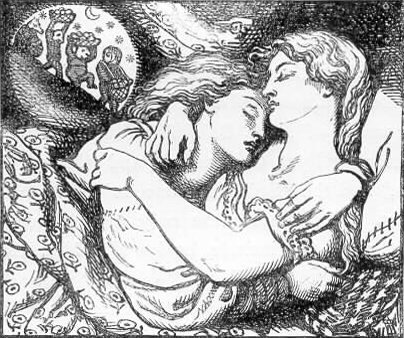

This work was for my ENG-1BH Class (Critical Thinking and Writing). The assignment was to make a feminist criticism of Christina Rosetti’s Goblin Market.
- This is one of my worser works, the whole thesis is bad because it tries to ambitiously compare 3 vaguely related people, stories, and fictional people.
- In retrospect, it probably could have been better with some better analysis taken from Hilford’s Guide to Literary Criticism
Elizabeth Browning once said, “A woman’s duty is to be a helpmeet to her husband, and to bear his children. But a woman has a right to her own person, and to the use of her own faculties” (Taylor 5). This kind of view in the modern era may be seen as anti-feminist, and writers like Rossetti who are “feminist” within the period may appear to have differing opinions. However, Rossetti had views just like these in her critique of Victorian hypocrisy. During the Victorian Era, gender roles were segregated into 2 spheres. The male sphere was invested in education and politics, and had to take a job, and provide and rule over their family. Women were expected to maintain a higher moral standard than men, and their purpose in life was to maintain chastity, get married, and take care of the family at home (caregiver). Women who became prostitutes, cheated on husbands, or were infertile immediately lost their place in Victorian society. At the same time, men could get away with some indecency and lack of Victorian moral high standing (Marsh 5). These double standards and the objectification of Women caused many in the Victorian era, 1837-1901, to critique this hypocritical view on gender culture. Christina Rossetti, born in the 19th century, is a female poet in the Victorian era, most famously known for her work “Goblin Market.” Every night in Goblin Market, two girls, Laura and Lizzie, are enticed to buy fruits with erotic undertones from Goblins. One day, while they were secretly watching the Goblins, Laura could not resist temptation and bought fruit from the Goblins. After eating the fruit, Laura falls gravely ill, yearning for the fruit, but never quite able to hear the Goblins cry. Concerned, Lizzie goes out to buy fruit to heal Laura, but instead of eating the fruit in front of the goblins, she gives it to Laura. The Goblins weren’t happy that Lizzie didn’t eat the fruit in front of them. The goblins then became infuriated, trying to rape Lizzie for not buying fruit with dignity and eating fruit in front of them, but Lizzie got away and healed Laura with the fruit. After Laura was healed, and they became old, the story ends with both of them married and with children, recounting to the young ones the story of the Goblin Market. Goblin Market isn’t meant to be interpreted literally, but allegorically. The fruits are sexual pleasures, and Laura is engaging in fornication by buying fruit with a lock of hair. Lizzie´s buying of fruit with a coin rather than hair represents not offering her dignity for the Goblin’s pleasure. While this poem is very feminist, Rossetti holds back on challenging gender roles, as the goal of the female characters is to get married and work as mothers. She also still considers that losing virginity is bad, and that redemption is required. Some suggest that this poem was inspired by Rossetti’s personal experiences doing charity work for “fallen women” who were prostitutes at St Mary Magdalene House of Charity. Rossetti’s “Goblin Market” blames men for infidelity more than women, and that purity can be gained through redemption; however, she still pushes for a Victorian—approach—to gender roles, and does not believe in women challenging men’s typical roles in society, comparable to female activists like Phyllis Schlafly or the fictional Serena Joy Waterford from Handmaid’s Tale; Rossetti is a form of proto-feminist.
Rossetti first criticizes the norm that infidelity is the woman’s fault through her portrayal of the Goblins and their goods. Conventionally, in Victorian culture, “fallen women” who committed sexual sin lost any social status they had, and were discriminated against and considered barren. The man they fornicate with, however, has no responsibility, as conventionally the woman is seen as the one who tempts. Rossetti first talks about the fruits that tempt Laura into buying to show that it is the man’s fault and unconventially, not the woman’s fault:
Come buy, come buy:
Apples and quinces,
Lemons and oranges,
Plump unpecked cherries
Taste them all and try:
Currants and gooseberries,
Brigh-fire-like barberries,
Figs to fill your mouth,
Citrons from the South,
Sweet to tongue and sound to eye;
Come buy, come buy (Rossetti 1; 1 . 1 4-31)
The goblin fruit vendors sell fruit, which can symbolize sexual pleasure, or generally as sin as an allusion to the forbidden fruit in Genesis. Since the Goblins are selling fruit to the girls, and not the other way around, Rossetti depicts men tempting women, rather than the other way around. This concludes that the woman is not to be “fallen”, but the man should be. Goblins not only advertise, but they also use vivid descriptions to encapsulate the sexual nature of the goods. Rossetti also makes us sympathetic to Laura who ends up becoming fallen, and not sympathetic towards the men who exploit her (Goblins), by contrasting them in their descriptions:
One [Goblin] had a cat’s face,
One whisked a tail,
One tramped at a rat’s pace,
One crawled like a snail,
One like a wombat prowled obtuse and furry,
One like a ratel tumbled hurry skurry,
Laura stretched her gleaming neck
Like a rush-imbedded swan,
Like a lily from the beck,
Like a moonlit poplar branch, (Rossetti 1; 1 . 3-4 71-84)
Goblins are described as animalistic and unpleasant animals at the minimum. Ratels, for example, are large black and white badgers that leave an odorous scent with their sexual glands. Rats are seen in this era as the cause of the plague in popular media, although modern evidence suggests fleas had more fault. Rossetti is intentionally depicting the Goblins negatively, and in turn, men. Contrasting with how she depicts Laura, juxtaposed right in the next stanza. Laura, who becomes a fallen woman, is depicted with positively associated adjectives and imagery. Laura is depicted as a swan, a lily, and like a moonlit poplar branch. Rossetti does this to make the reader pity Laura more than the Goblins, by portraying Laura with peaceful and feminine imagery. This adds to Rossetti’s view of men and her view of “fallen women” at the time.
Another important critique that Rossetti gives through “Goblin Market” is that sexual sin is redeemable, especially with sisterhood. After Laura buys fruit with her lock of hair, and eats it becomes ill and stuck in bed, representing her turn into a fallen woman. Even though Victorian though suggested that fallen women were fallen forever, Rossetti depicts Lizzie, a sister in womanhood, saving her from the tragedies of sexual infidelity. After Laura falls ill, Lizzie goes out to buy fruit to heal her from the Goblins, “‘Good folk [Goblins],’ said Lizzie, … ‘Give me much and many:’ / Held out her apron, / Tossed them a penny” (Rossetti 3; 1 . 5 363-367). One key difference between Laura’s buying and Lizzie’s buying of fruit is what they offer in exchange. Laura offers her dignity, symbolized by her giving her precious lock of hair. While Lizzie offers a coin, which costs no expense towards her dignity; the Goblins are infuriated by her lack of offering dignity and attempt to rape her at no avail. Rossetti later shows Laura back to full domestic sphere capacity by being healed by fruit, “Laughed [Laura] in the innocent old way, … Her gleaming locks showed not one thread of grey, / Her breath was sweet as May” (Rossetti 4; 1 . 6 537-541). Not only did Laura regain beauty, but also societal acceptance, “Days, weeks, months, years / Afterwards, when both were wives / With children of their own;” (Rossetti 4; 1 . 7 543-545). One of the key privileges and roles of women in Victorian society was to get married and have a family, and even though Laura was “fallen,” she regained her role in society as a Woman. Rossetti’s view on infidelity and women can be summarized by one quote by her: “[Those other virtues besides purity] are promoted by dwelling on the antagonistic vices; by coming, so to say, to close quarters with these, by waging war with them face to face … [The vice of] “impurity,” however, calls for the opposite response: to “cover and turn away the eye lest it should behold it” and to “stop the ear lest it should admit it” (Escobar 97). Rossetti views on infidelity is that an infidel shouldn’t be excluded or discriminated against, but be turned a blind eye, and supported by sisterhood. Rossetti finds that there is redemption for women out of line in a traditional patriarchal society, and that women, fallen or not, can achieve a high status in society.
While Rossetti advocates a radical view that infidelity isn’t a woman’s fault, and that this kind of sin is redeemable, she falls short on modern feminist viewpoints that suggest infidelity is not a sin at all, or that redemption is unnecessary. These kinds of viewpoints can be parallel to that of Phyllis Schlafly and Serena Joy from The Handmaid’s Tale. Her advocacy for fulfilling the woman’s role in a traditional marriage likens her to later “feminists” like Phyllis Schlafly. Rossetti shows that giving in to sexual temptation is bad by this dialogue from Lizzie, who is sympathetic, “‘No’ said Lizzie: ‘No, no no; / Their offers should not charm us, / Their evil gifts would harm us’” (Rossetti 1; 1 . 3 64-67). Lizzie says that the fruits of the Goblins (sex) are something to be avoided, and that the Goblins’ cry for buying isn’t normal business marketing but evil temptation. Rossetti also depicts that there are consequences for being an infidel, not just Laura getting ill, but another character, Jeanie, dying from this sin. Rossetti states:
She [Lizzie] thought of Jeanie in her grave,
Who should have been a bride;
But who for joys brides hope to have
Fell sick and died (Rossetti 3; 1 . 1 330-345)
Jeanie fell for the Goblin’s fruit and bought some with her dignity, causing her to fall ill and die. Rossetti clearly shows that infidelity causes death, just like “for the wages of sin are death”, meaning Rossetti perceives infidelity as an undesirable sin. Here, Rossetti also explicitly states what the fruits represent, “joys brides hope to have”, or sex. Not only does Rossetti perpetuate the idea of sexual sin, but she also perpetuates traditional Victorian gender sphere ideology. Rossetti concludes “The Goblin” with her version of the happy ending:
Days, weeks, months, years
Afterwards, when both were wives
With children of their own;
Their mother-hearts beset with fears;
Their lives are bound up in tender lives; (Rossetti 4; 1 . 7 543-547)
Rossetti’s depicts Laura and Lizzie after being forgiven of sexual sin in their prime, married and with children. She also depicts the domestic sphere role of women as being “bound up in tender lives”, supporting the idea that marriage and children is the ideal goal for any good woman. Not to also add with a previous quote, “Who [Jeanie] should have been a bride”, which states that as a result of infidelity, Jeanie missed out on the ideal married Victorian woman’s life. Add finalizing thoughts and link to thesis. Someone else who believes a patriarchal society can still breed equality despite gender roles is Phyllis Schlafly. During the women’s suffrage movement in the United States, Schlafly was at odds with the feminist movement as she saw it as betraying women’s rightful place as homemakers and mothers. Just like Rossetti, Schlafly also believes that morality shouldn’t have double standards for men. Andrew Koppelman at Harvard Law, arguing against Shlafly’s views on the regulation of pornography, said about her, “She wants to suppress pornography because it helps to reinforce a vernacular masculine culture that is indifferent or even hostile to the needs of women and children” (Koppelman 1). Schlafy believes men are perpetrators in sexual crimes, just like Rossetti with the Goblins raping Lizzie. But both of them represent an intermediary between an absolute Victorian perspective and a modern feminist viewpoint in that they both believe gender roles are a beneficial thing to society as a whole. The Womans Policy Journal writes on an interview dialogue between two leading women activists, Shlafly and Barbara Ehrenreich (activist wanting to close wage gap between men and women):
Shlafly
The feminist movement has had a powerful negative impact on women because it makes women believe they are victims of an oppressive patriarchal society. Feminist consciousness-raising is based on identifying and exaggerating grievances against men. Victimology is not conducive to happiness or success in marriage or the workforce. American women are the most fortunate class who ever lived on the face of the earth, a status due to our unique constitutional structure, the high role accorded to women by Christianity, and the American private enterprise and patent systems that produced marvelous inventions that have so reduced the work required to maintain a household. (Schlafly 2)
Schlafly believes that by Victorian traditional gender roles, women can have privilege and happiness in their lives. She believes that women who advocate for rights believe they are the victims, as traditional gender roles are what give them rights. This draws parallels between Rossetti and Schlafly, but what is an even better representation of Rossetti’s ideals is that of fictional character Serena Joy Waterford in The Handmaid’s Tale by Margaret Atwood. The Handmaid’s Tale is a critically acclaimed book that follows the journey of the main character Offred (June) who is a handmaid (slave who births children for infertile families) entrusted initially with the Commander Waterford and his wife Serena Joy Waterford in the country of Gilead (previously the United States). Serena Joy canonically in The Handmaid’s Tale helped create the theocratic patriarchal country of Gilead, even though she was a woman. She wrote a book urging the return of women to the private sphere (cooking and cleaning), and helped garner support for a country that would eventually ban women from reading or writing.
Serena published a book calling for women to retreat to the private sphere to raise healthy families (failing to reflect on the irony of her public role, of course). Similarly, some women are in positions of control over others in Gilead, such as the Aunts’ mission to train women to be Handmaids and their often violent enforcement of obedience. It is precisely the relationship between Serena and June that allows for the exploration of the politics of power among women who, although from different ideological strata, decide to work together. This bond that little-by-little grows between them receives narrative attention in order to explore what constrains and hinders it. For example, in the episode “God Bless the Child,” June confesses to Serena that she has suggested to Commander Waterford that he should give Serena more freedom, but Serena retorts, “To do what?” June answers, “As Mrs. Waterford you have influence. Access. Power.” Serena complains that she has influence only “up to a point,” to which June responds, “So, move up the point. Like what we did before (Gámez 5)
Serena who converted America into the incredibly sexist state of Gilead was advocating for a return to Victorian ideals, and in bad faith witnessed the repercussions later. Serena tried to gain power within the patriarchal society by advocating for women to be taught to read, reading the bible in front of governing officials, and having a finger cut off for the crime of reading. Serena is popular for advocating a procreationalist and traditional gender roles in society by disguising it as feminism. Rossetti is the same as Schlafly and Serena Joy; they all advocate for traditional gender roles as a form of “feminism”, helping women achieve a place in society. But that is exactly what is dangerous, that they are viewed as feminists when they advocate for policies that restrict their rights. Serena Joy is a prime example, having her finger cut off for reading, when she advocated earlier for these kinds of policies.
Rossetti portrays in her poem “Goblin Market” that infidelity isn’t entirely the woman’s fault, and is redeemable. But she still stands on traditional gender roles and the view that infidelity before marriage is a sin. This may seem like a small fact, given the era she grew up in, but this kind of ideology is dangerous, drawing parallels with Phyllis Schlafly and Serena Joy Waterford from The Handmaid’s Tale. It would be interesting to see what kind of views Rossetti would form about feminism if she grew up in a different era; perhaps she would abandon conservative feminism and be a full-on suffragette.