
A while ago, I experimented to test the effect of an electrical current on plant growth. It was an experiment with mixed results, which oddly used aluminum and copper as electrodes, and the results were inconsistent.
But tomorrow I plan to redo the experiment to get conclusive results and explain many of the mysteries of the project.
The project I did in middle school:
I was maybe in 7th grade in middle school when I chose to research the effect of electricity on the growth of plants. There is some vague research on this topic, but most of it can be categorized by either Electropism or Electroculture. The latter of which is mostly pseudoscience, and the former is more related to physiological growth tendencies of organisms under current conditions.
To put it simply, there is basically no research on this topic that has made any meaningful results that can be reproduced. That’s why I found it a perfect science fair project.
I worked on it for a while and found some interesting results when mung beans are sprouted within an electrical current:

By the way, you can access my science fair project here (it may have some stuff missing or unclear). As shown in the figure above, you can see that out of 8 beans, the electrically applied beans sprouted faster. However, as you can see on day 4 of the experiment, one of the beans from the 4-volt category died.
The reason for the death was actually something that stumped me for a long time, because many other electrically applied plants seemed to die out of nowhere from a blue-purple “mold” like thing. It turns out that it was likely copper deposited onto the plant by ion transfer.
Already, that is evidence that electricity has some effect on the growth of plants, and that it is a promising sign for future investigation.
There is more evidence that shows a similar “boom-bust” cycle of electrical benefits to plant growth, like the ones below:


As you can see, there is some initial boosted growth occurring under electrical current, but then the control without electricity overtakes, and the electrically applied plants mysteriously die because of the copper electrode poisoning the plants.
Here is more evidence showing that the cause of death for my experimental beans was not electrical current, but rather the mysterious “mold” (which is actually deposited copper and aluminum)

What if the electrode did not poison the plants? Would the plants overtake the control? Is what determines whether plants thrive under electrical current genetic?
All of these questions I hope to answer by redoing my science fair in a more controlled fashion.
Part 2
As I’ve said before, the questions I hope to answer by my rediscovery of my old science fair project are:
- Does electrical current clearly and statistically significantly affect plant growth?
- What is the precedent for improved response to electrical current? Physiological? Genetic?
To quickly answer these first 2 problems without in-depth analysis, tomorrow, on December 22nd of 2025, I will conduct an experiment that should vaguely answer these 2 questions.
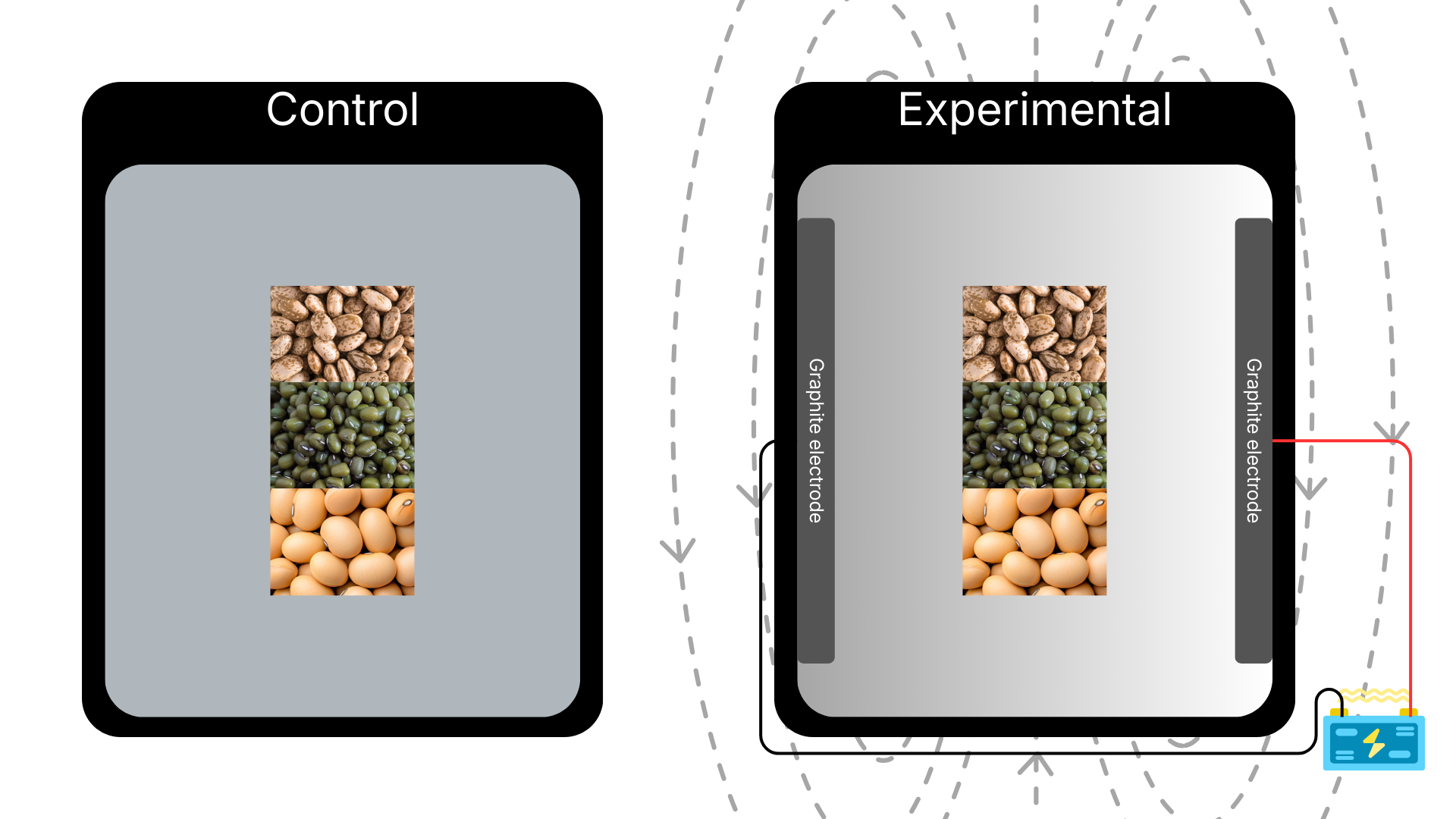
Using 2 identical polypropylene containers with pure 0.8% w/v (g/L) agar medium, with an equal amount of different kinds of beans (pinto, soybean, mungbean) in each container, I will seek to find out the effects & precedent of electrical current on plant growth.

This experiment is heavily inspired by tissue culture methods, especially because of how sterile it is supposed to be (I will autoclave these containers). One container is normal; meanwhile, the other is retrofitted with graphite electrodes. The one with graphite electrodes will undergo an electrical current (I’m thinking about using DC 6 volts, but maybe use AC in the future)
Graphite is crucial as the electrode since it will not release poisonous ions into the medium, as my original experiment did. The seeds will be bleached and sterilized in a 10% household bleach + 1 drop dish soap solution, then washed in purified water, and then placed into these containers. These containers will be monitored 24/7 with a webcamera (one that I already have), and I am going to track the time it takes for both the control and experimental beans to sprout.
If there is a significant difference in sprouting times between the experimental and control containers, that means that electricity affects plant growth (and since this is pure agar medium, we can discount electrochemical gradient effects). And if the difference in sprouting times between different species of beans is different, that suggests (not proves unfortunately) a genetic precedent for growth under electric behavior.
After
If the results were inconclusive of my hypothesis, I probably will tweak what kind of electrical current I use, or the ionic composition of the agar medium (I will try to use non-crucial, non-toxic ions), to achieve something interesting for further pursuit.
Right now, I am sprouting makeshift pinto beans to further research my genetic predisposition hypothesis to clone and grow electro-compatible pinto bean plants (maybe even think about direct evolution).
I have bought MS nutrients, 6-BAP, and NAA to clone these plants to further research the genetic predisposition in plant growth under electrical current. And I am currently in the process of figuring out how to automate analysis with R and the lab protocols with Arduino boards, but it is only soon when I will achieve results…