
I said last year (less than 2 weeks ago) that I would do an experiment testing if the effects of electromagnetic plant growth induction depended on species.
The results I hoped to get the next day with my camera setup, but many things caused the results to get delayed until now.
Right after I posted the last post, I made a polypropylene (autoclave safe) container with hot glue to attach the graphite electrodes to the container. When I autoclaved the container (in an Instapot), the glue all melted, and my agar was at the bottom of the container; it was already 10 pm so I decided to wait until tomorrow.
The next day, I tried making another polypropylene container with agar and hot glue to attach the graphite electrodes, but I did not autoclave the agar and instead decided to put the contraption in the microwave. The agar used had 10 millimolar Borax (the anhydrate), which I was thinking would not affect plant growth but would increase molar conductivity. I set up a camera to observe the sprouting of the 6 pinto beans, 6 mung beans, and 6 soybeans on experimental and control agar plates. I noticed that the hot glue was not able to keep the agar from leaking, but I did the experiment anyways.
I waited 3 days, and none of the beans sprouted, so I called it quits and cleaned the agar that was leaking on the setup. Borax was probably a mistake, so I tried the same experiment again, but with citric acid and sodium bicarbonate; I made sure to add millimolar amounts that would keep the agar slightly acidic (citric acid is really strong for a weak acid). I would have used an ICE table to figure out the amounts needed of baking soda and citric acid to get around 5.4 pH with 20 milimolar total, but decided to just do it by adding baking soda until 2 milimolar citric acid became around 5 with a pH test strip (citric acid has 3 equilibrium constants that are relatively close to eachother, so x-approximation is impossible).
The polypropylene lid that came with the containers was not really transparent, but instead half-transparent with a blur filter for some reason; Saran Wrap was supposed to fix it by being more transparent than PP. What ended up happening was that the Saran wrap shone light back onto the phone camera I was using, and also allowed water to condense onto the lid. I used a rubber band to seal the Saran wrap on the control, but found it impossible to do with the experimental, with all of the wiring; the experimental was left with open air holes for mold and other things to get in.
I waited 2 more days and found nothing growing in the citric acid + baking soda agar plate either, but I let it sit out in case something grew later (I really doubted that the agar was toxic). My Murashige and Skoog from RPI finally arrived, and I was ready to try it instead as a means to make the agar conductive. I also used new circular polypropylene containers because my previous container had vents to let air out (not sterile), and Saran Wrap (PE) to imitate the Phenomenon research paper’s attempt to make phenotyping (quantitatively measuring plant growth) easier for in-vitro plants; an experiment I will do later with my gene library of pinto bean plants. I used around .046 grams of MS for 200 mL and found that the agar had a resistance of 600 thousand Ohms: pretty bad, but good enough. I then microwaved the 400 mL beaker to heat the agar, not knowing if it would explode because the beaker didn’t say what kind of glass it was (found out later it was Borosilicate). Nothing exploded, thankfully, but when I poured it into the containers I quickly noticed that a big amount of agar powder was being deposited on the bottom of the beaker. I ended up with one PP container becoming liquid, and the other becoming really solid. I put the seeds inside while it was still steaming, and used a new camera setup to see what would happen.
The camera saw nothing because quickly the Saran Wrap became full of steam, and previously it was too shiny. Also, I noticed no growth since then.
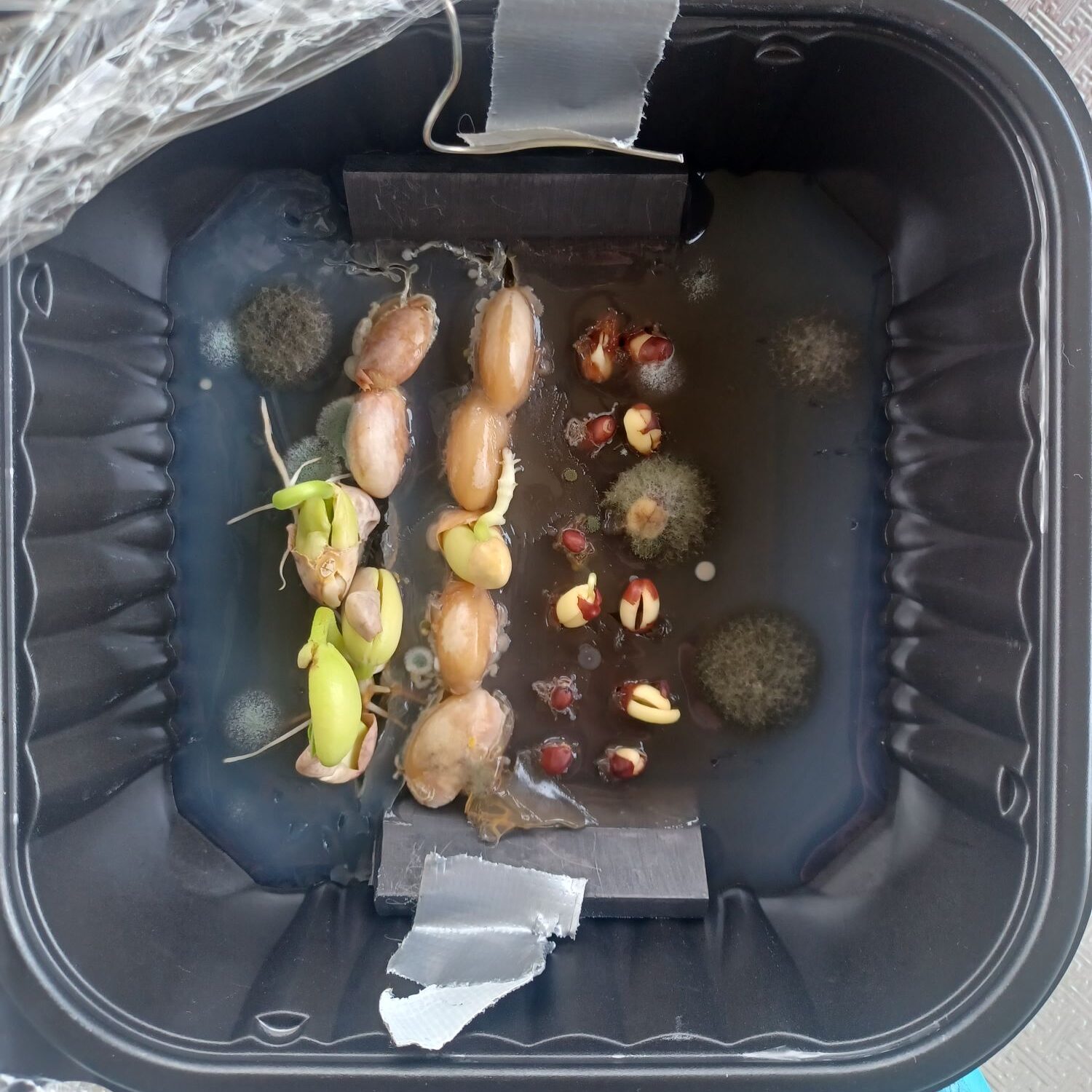
Luckily, the citric acid + baking soda experiment showed results after 6 days, alongside some mold that grew.


From what the images show, the control has sprouted around 2 soybeans, 1 pinto bean, and 3 mung beans. While the experiment has sprouted around 3 pinto beans, 1 soybean, and 1 mung bean. Something interesting is that the experimental group seems to have larger but fewer mold colonies compared to the control.
Before I make any conclusions, I have to say that the mold makes the experiment impossible to generalize. I also remember changing the voltage several times in a desperate attempt to speed up growth. By being electrified, the sprouting rate changed differently for each species: pinto beans increased sprouting rates, soybeans decreased (insignificantly), and mung beans decreased as well.
Pinto beans and soybeans have around the same size, and similar physiological features; it can therefore be assumed that physiology does not affect the different effects of electrical plant induction (growth) in this instance, at least. Pinto beans increased under electrical current, while soybeans decreased; electrical plant inductance probably has a genetic predisposition.
A more conclusive way to prove genetic cause is to find a bean genetically similar to pinto beans/soybeans, but has an abnormally different physiology, and redo the experiment. This can be used to figure out whether physiology or genetics has a bigger role in electrical plant inductance, and that is something I will figure out later.
In any case, I am going to figure out a way to propagate my gene library with tissue culture; I am waiting for the 6-BAP to arrive to do this. I am also going to use silicone sealant and graphite rods (1mm thick) instead of graphite bricks to attach the electrodes in a sterile manner, and use PVC foil instead of PE Sarran Wrap to achieve clearer lids for the tissue culture containers.