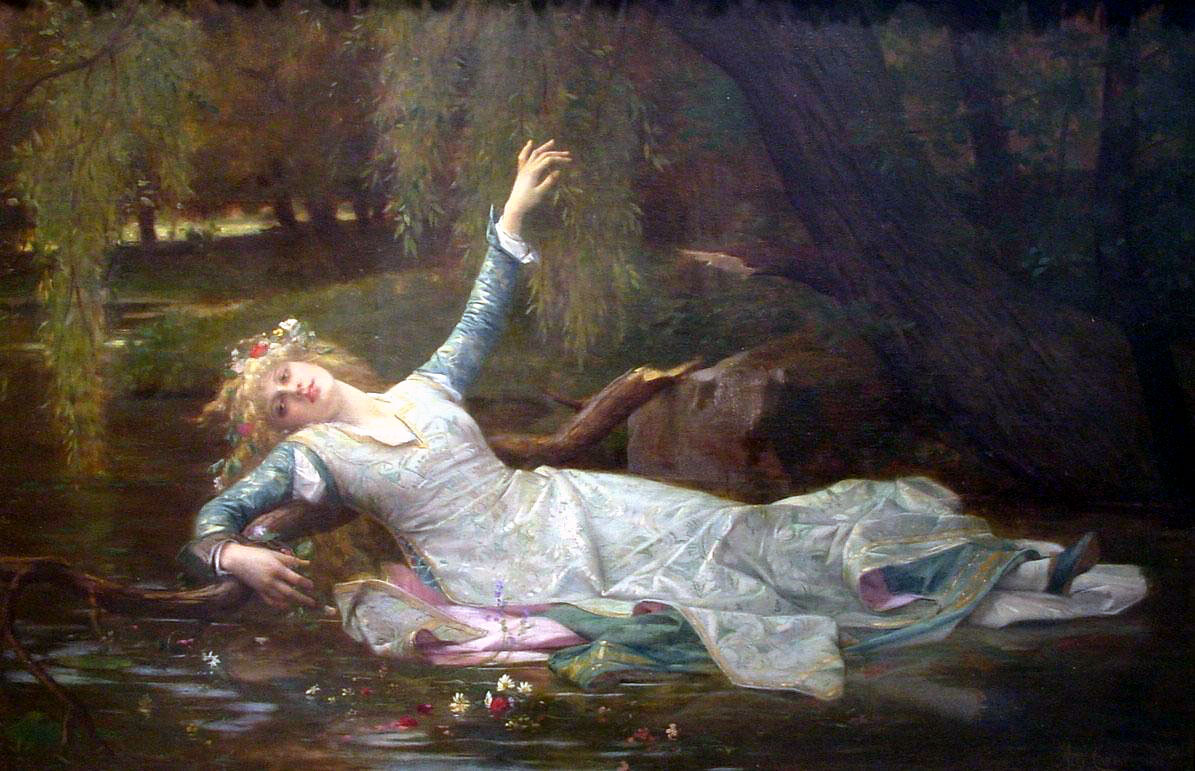

This essay was for my ENG-1BH (Critical Thinkin and Writing / AP English). The prompt was to make a psychoanalytical critique of Hamlet. I choose to assess the mental state of Ophelia using the DSM-5. This essay was my best work in the class, getting the highest score.
- Sigmund Freud would have been proud of me, despite my rejection of his methods.
In Shakespeare’s Hamlet, Ophelia sang, “You may wear your rue with a difference. There’s a daisy. I would give you some violets, but they withered all when my father died. They say ’a made a good end ‘For bonny sweet Robin is all my joy.’” Ophelia is best known in Hamlet for dying mentally ill after her father’s death. She was submissive, but also holding back. What predisposed her to mental illness was the chronic control over her life. Women are more than 2 times more likely to receive a diagnosis for Dependent Personality Disorder than men (Borenstein 2). There are many hypotheses as to why there is a gender discrepancy in DPD (Dependent Personality Disorder) diagnosis, some suggesting bias, or gender constructed diagnostic criteria. However, one of the most obvious things to highlight first is the historical developmental differences between women and men. Childhood developmental hypotheses suggest that the authoritarian style of parenting that women receive as children, and their lack of free will throughout life, predisposes them to DPD. How this ties back to Ophelia is that she would fit the criteria to be diagnosed with DPD, and this DPD could have catalyzed her death & craze. Ophelia, in Shakespeare’s Hamlet, is not just dependent and servile to Polonius, but also to her brother and even to Hamlet. Diathesis-stress models of psychopathological etiology (cause) suggest that disorders can be precedents for other disorders. Ophelia’s dependent disorder precendent for delirium. DPD, the diathesis (cause), and Polonius’ death, the stressor, Ophelia went mad. Ophelia’s overt dependence on male figures in childhood causes her personality to become maladaptive with elements of Dependent Personality Disorder; this causes Ophelia to have an inordinate response to her father’s death in the form of psychosis, leading to her death.
Ophelia’s childhood was focused on forming obedience towards patriarchal figures like her brother, father, and later, Hamlet. Although Shakespeare’s Hamlet does not give much information about Ophelia’s childhood, it is inferable from her social status and interactions with patriarchal figures like Laertes, Polonius, and Hamlet what kind of childhood she had. Ophelia is a noblewoman, and this is shown because of her father’s (Polonius) close relationship with the King, Claudius. Given that she is a noblewoman, she may be severely socioculturally restricted. On matters like marriage, for Ophelia, they could not be of love, but only arranged for her father, Polonius’s, political benefit. An example of a precedent of being lectured by patriarchal figures is when Ophelia is talking with Laertes. Ophelia tells Laertes of Hamlet’s love for her, and from then on, Laertes goes on to lecture her about how she should avoid interacting with Hamlet, “Think it no more. / For nature crescent does not grow alone / In thews and bulks, but as this temple waxes, / The inward service of the mind and soul / Grows wide withal. Perhaps he loves you now, / And now no soil nor cautel doth besmirch / The virtue of his will, but you must fear, / His greatness weighed, his will not his own. / He may not, as unvalued persons do, / Carve for himself, for on his choice depends / The safety and health of this whole state / … / Fear it, Ophelia, fear it, my dear sister, / And keep you in the rear of your affection” (Shakespeare, 20)
Laertes, who is Ophelia’s brother, is acting almost parent-like to Ophelia. She does not exhibit a normal sibling relationship; she exhibits a dependent one. This kind of relationship could have only been formed as a precedent in childhood. Another example of subservience is when Ophelia is being controlled by her father, as shown by the dialogue between her and Polonius:
OPHELIA: He hath, my lord, of late made many tender Of his affection to me.
POLONIUS: “Affection”? Pooh, you speak like a green girl,
Unsifted in such perilous circumstances.
Do you believe his “tenders,” as you call them?
OPHELIA: I do not know, my lord, what I should think. (Shakespeare 23)
This passage may look like just Polonius also lecturing Ophelia on the dangers of love relationships, but it also has a subtle, dark undertone. The line “I do not know, my lord, what I should think” is not just Ophelia admitting confusion; it shows that she has fear of revealing what she believed earlier. In front of Polonius, Ophelia loses self-agency and is instead coerced into agreeing with Polonius. The diction used in that line suggests that there is a refrain in her thought process, in a way, asking for dear forgiveness for believing Hamlet’s love for her is genuine. She is not only judged by her actions, but also by her thoughts. This kind of fear that Ophelia has suggests that Polonius has employed authoritarian parenting or was emotionally/physically abusive to her to get her in line. With her lover Hamlet, Ophelia also exhibits this same subservience. Although Hamlet is not a relative of Ophelia, subservience is observed when Hamlet pretends to be crazy to deceive the King, and tells Ophelia that he never loved her:
HAMLET: Ay, truly, for the power of beauty will sooner transform honesty from what it is to a bawd than the fore of honesty an translate beauty into his likeness. This was sometime a paradox, but now the time gives it proof. I did love you once.
OPHELIA: Indeed, my lord, you made me believe so.
HAMLET: You should not have believed me; for virtue cannot so innoculate our old stock but we shall relish of it. I loved you not.
OPHELIA: I was the more deceived. (Shakespeare 58)
Hamlet tells Ophelia twice that he never loved her. Yet instead of having rage or contempt, she attacks herself for being foolish. Despite Hamlet wronging her, she only blames herself. She was raised in a way that everyone besides her, family or not, is always, always, right.
Ophelia exhibits many characteristics that can be associated with Dependent Personality Disorder, and this diagnosis affects how stressors lead to the development of further mental health complications. According to the DSM-5 TR, for an individual to be diagnosed with Dependent Personality Disorder, the individual must exhibit at least 5 of the mentioned symptoms:
1. Has difficulty making everyday decisions without an excessive amount of advice and reassurance from others.
2. Needs others to assume responsibility for most major areas of his or her life.
3. Has difficulty expressing disagreement with others because of fear of loss of support or approval. (Note: Do not include realistic fears of retribution.)
4. Has difficulty initiating projects or doing things on his or her own (because of a lack of self-confidence in judgment or abilities rather than a lack of motivation or energy).
5. Goes to excessive lengths to obtain nurturance and support from others, to the point of volunteering to do things that are unpleasant.
6. Feels uncomfortable or helpless when alone because of exaggerated fears of being unable to care for himself or herself.
7. Urgently seeks another relationship as a source of care and support when a close relationship ends.
8. Is unrealistically preoccupied with fears of being left to take care of himself or Herself. (American Psychological Association 768)
Ophelia, in particular, exhibits symptoms (1), (2), (3), (4), and (5). For symptoms (1 & 2), “Has difficulty making everyday decisions without an excessive amount of advice and reassurance from others / Needs others to assume responsibility for most major areas of his or her life,” it is clear that Ophelia’s life is constantly being led by patriarchal figures; everyday decisions like who she talks with & what she does, decided by others. At the end of Polonius’s dialogue with Ophelia, she followed Polonius’s orders not to talk with Hamlet, and obeyed all the way. For symptom (3), “Has difficulty expressing disagreement with others because of fear of loss of support or approval,” as mentioned before, there is evidence that in front of Polonius, she fails to express disagreement with Polonius’ verdict that Hamlet’s love is false. For symptom (4), “Has difficulty initiating projects or doing things on his or her own,” there is already evidence that most things she does are led by others. Ophelia did not initiate a relationship with Hamlet, although she loves Hamlet; it is he who woos her. When Laertes talks about Hamlet, he claims that Hamlet’s favor was placed by him upon her, “For Hamlet, and the trifling of his favor [love].” This means that even if Ophelia loved Hamlet first, she lacked the initiative to tell Hamlet, and instead had to have Hamlet tell her. And finally for symptom (5), “Goes to excessive lengths to obtain nurturance and support from others …,” to maintain favor with Polonius, she heeds Polonius’ word to find out what is wrong with Hamlet. She, in essence, is helping Polonius spy on her lover to maintain Polonius’ nurturance and support. In total, it is evident that Ophelia meets the criteria for Dependent Personality Disorder. The implications of having such a disorder are severe. Polonius’s death, for example, is a traumatic experience that may lead to the development of further mental issues.
Giannopoulou et. al. find in a large-scale study that around 37-46% of individuals with psychotic disorders have had a traumatic event right before their symptoms appeared (Giannopoulou et. al. 6). Under normal circumstances traumatic death of relatives results in depression, but because of Ophelia’s Dependent Personality disorder, the development of something severe, for example psychosis, is not unlikely and certainly possible. After Polonius died within Hamlet, there is evidence of Ophelia contracting psychosis. Ophelia exhibits many symptoms of developing psychosis after Polonius’s death, including idiosyncratic speech, incoherent thought, and hallucinations (American Psychological Association 568). A stock character within Hamlet, Gentleman, tells Gertrude of how Ophelia has been doing after Polonius’s death, “She [Ophelia] speaks much of her father, says she hears / There’s tricks i’the world, and hems, and beats her heart, /Spurns enviously at straws, speaks things in doubt /That carry but half sense. Her speech is nothing,” (Shakespeare 93). After Polonius’ death, Ophelia exhibits paranoid and jealous delusions within her speech. In addition, according to Gentleman, all that she says is nothing: idiosyncratic. The Queen, reluctant to see Ophelia, finds her in a mess. Ophelia then goes on to perform such idiosyncratic speech in front of Gertrude, ignoring what Gertrude says, and singing songs of unclear symbolic meaning:
QUEEN: How now, Ophelia?
OPHELIA (She sings): “How should I your true love know
From another one?
By his cockle hat and staff
And his sandal shoon.”
QUEEN: Alas, sweet lady, what imports this song?
OPHELIA: Say you? Nay, pray you, mark.
“He is dead and gone, lady, Song.
He is dead and gone;
At his head a grass green turf,
At his heels a stone.”
Oho! (Shakespeare 98)
Gertrude is just confused, and asks Ophelia what is happening, a little unwilling to hear what she says. Ophelia then just says an unknown song about love. The Queen interjects and asks why she is singing, to which Ophelia then ignores her and asks her to listen with attention, “mark”, she says. Ophelia then switches to a different song about her dead father, Polonius, within her grave, switching from love to death (an entirely different song), a psychotic symptom of an incoherent thought train. Later, Ophelia leaves, then Laertes comes to confront Claudius, then Ophelia comes back in, and in addition to her idiosyncratic speech, she talks to imaginary people to perform a song with her. Ophelia’s symptoms are progressively getting worse. Ophelia says, “You [not anyone in the room, someone imaginary] must sing ‘A-down, a-down,’ and you [another imaginary person] ‘call him a-down-a’ Oh, how the wheel becomes it? It is the false steward that stole his master’s daughter” (Shakespeare 98). Talking to imaginary people is indicative of hallucinations, a symptom of psychosis. Ophelia went from simply idiosyncratic speech and incoherent thought, all the way to hallucinations; her psychosis is only getting worse. Since it is established that Ophelia had psychosis (and by the minute getting worse), this provides two implications: she may not operate at full cognitive capacity, and she may develop psychotic suicidal ideations. Within Hamlet, it is debatable whether Ophelia’s death is a suicide or an accident. Regardless, both suicide and accidental death can be ultimately caused by the implications of psychosis. Around 73% of individuals experiencing psychosis have suicidal ideation, especially the first day of their symptoms (Castelein 4). The incoherent thought train and hallucinations part of psychosis yields schizophrenics and others with psychotic symptoms to have many accidents, impairing their ability to live life (Castelein 6). Ophelia accidentally fell off a branch and drowned, or killed herself in the river. Regardless, it is the culmination of Ophelia’s restrictive childhood and DPD onset, that causes the psychotic nature of her death.
The cultural and social situation of Ophelia causes her adolescence to set a precedent for the development of a dependent personality disorder, presenting itself as a catalyst for the sudden onset of psychosis after Polonius’ death; psychosis presents itself to explain Ophelia’s death, whether suicide or accident. Ophelia’s childhood is such a risk factor for the development of DPD; the interactions she has with Laertes, Polonius, and Hamlet exhibit how she was treated when she was young: to be obedient, unquestioning, and poised. Not only that, given the evidence within Hamlet, Ophelia already meets the requirements for diagnosis of Dependent Personality Disorder, shaped by how she was treated in childhood. DPD is defined by being obedient to many figures, and a leader figure, like Polonius. The death of such a leader, in an etiological perspective, can serve as the stressor triggering the sudden onset of psychosis. This psychosis leads to her demise, yet no one cares for her. The signs are obvious of a deteriorating psyche, yet they let her die. People should look out for one another, and recognize the inherent risks of this kind of childhood.